-trans.gif) |
 |
|
|
Midwest Today, Spring 1998
A hundred years after Americans first enjoyed the convenience
of having water piped into their homes, concerns are being raised
about the safety of the nation's water supply. The problem is
especially acute here in the Midwest, due to agricultural runoff,
which introduces harmful pesticides and other farm chemicals into
the lakes and rivers which supply much of our region's municipal
water needs.
This isn't another "global warming"- type scare that's
eons away. It is a present-day threat which can have serious health
consequences. Just ask anyone who lives in Milwaukee, Wisconsin.
Residents there still recall a contamination problem in 1993 when
a microbe called cryptospor-idium infiltrated that city's water
system and sickened 400,000 people, as well as killed 100 persons
who had weakened immune systems.
Cryptosporidium isn't the only danger that may be lurking in our
water. There are other lesser-known pathogens and stray bacteria,
and in some places dangerously high levels of mercury. And to
cope with lead that leaches into the water supply from old pipes,
some cities are now dumping orthophosphate, a powdery chemical,
into water supplies. Even the chlorine that is widely used to
purify water has hazards of its own: The American Journal of Public
Health reported in 1992 that drinking chlorinated water increases
the risk of bladder and rectal cancer over long periods of time.
Recognizing these risks to public health, the Environmental Protec-tion
Agency will soon be requiring water companies to disclose contaminants
in city water supplies, and issuing warnings against eating fish
from certain regions.
It is now clear that for more than 25 years, millions of people
living in hundreds of Midwest communities have been routinely
drinking tap water contaminated with an unhealthy dose of agricultural
weed killers, many of which are known carcinogens.
An analysis by the Environmental Working Group (EWG) in June 1997
showed that a single glass of Midwest tap water commonly has a
mixture of three or more pesticides, and has had for many years.
During its third year of testing, the ewg found ten different
pesticides and metabolites in a single sample of water taken from
a tap in
Williamsburg, Ohio, a Cincinnati suburb.
That was the worst case it found in its limited testing. But when
the group analyzed 1996 data collected by state agencies across
the corn belt, it found that 104 communities, with a total population
of 3.3 million people, drank tap water contaminated with five
or more toxic weed killers. And, the ewp noted, "this is
after a number of water utilities began special treatment to suppress
pesticide levels."
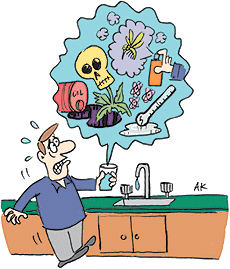 Little did we know that pesticides
were in our water, our iced tea, our orange juice, our infant
formula, or in the jet of water squirting from water fountains
at our children's schools and playgrounds.
Little did we know that pesticides
were in our water, our iced tea, our orange juice, our infant
formula, or in the jet of water squirting from water fountains
at our children's schools and playgrounds.
"[People] had no idea that they were often drinking -- or
serving their children -- poisons like atrazine, simazine, cyanazine,
metolachlor and alachlor, or various metabolites of these weed
killers that can be even more toxic," concludes a study by
the EWG.
The reason we didn't know that our water has been contaminated
with pesticides all these years is that no one told us.
The blame seems to rest with the multi-billion dollar chemical
companies that make these pesticides, who never said a word over
decades of contamination.
Even as utilities tighten their monitoring of treated water, and
reports of sporadic disease outbreaks subside, a greater problem
looms just beneath the surface. In much of the country, underground
water mains and connecting pipes are in some cases over 100 years
old. Leaks allow contamination in. And lead pipes may carry traces
of that toxic element into the home.
Obviously, if you put clean water into dirty pipes, you have dirty
water.
While politicians like to assure themselves of re-election by
fashioning ill-advised tax reductions, local municipalities are
strapped for cash to deal with the massive replacement of worn-out
water pipes.
Until the aging u.s. water system is overhauled, it is possible
that more and more Americans will buy bottled water instead of
turning the tap. Here again, there are problems. The fine print
on some bottles indicates it's from "municipal sources".
Meaning it's not necessarily any different from what you can get
from the tap -- though you pay a lot more. The Food and Drug Administration
may require "right-to-know" labeling on bottled water.
Regulations Targeted
EPA Administrator Carol Browner said urban and agricultural runoff
accounts for half of the pollution in the nation's lakes and rivers,
and waste "from animal feeding operations in particular has
been associated with threats to human health and the environment."
The EPA intends to regulate large poultry and other livestock
farms, or feedlots, to curb pollution into nearby waterways to
the same extent that factories are currently regulated under the
Clean Water Act.
The controls would not apply to cattle ranches, but only to feedlots
where the livestock are fattened before slaughter. Beef or dairy
cattle, hog and poultry farms would be subject to regular inspections,
require pollution permits and be required to develop plans limiting
release of chemicals, manure and other wastes into waterways,
the agency said.
Such pollution has been blamed for excessive nutrients and toxic
chemicals getting into lakes and streams, leading to a growing
number of fish kills in waterways in many parts of the country.
The flow of large amounts of nutrients from livestock into rivers and streams also has caused oxygen-choking algae blooms in waterways, creating in some cases "dead zones" where fish and other aquatic life no longer can survive.
Mercury Levels High
Meanwhile, still another water-related problem involves fish from
more than 1,660 U.S. waterways. This seafood is so contaminated
with mercury that it should not be eaten or eaten only in limited
amounts, according to federal health warnings. Children and mothers-to-be
are at highest risk, not only from fresh fish but from mercury
contamination of canned tuna and other foods.
There have been fish advisories from mercury contamination in
37 states. Mercury levels have even been found in supermarket
products such as tuna, fish sticks, even instant oatmeal.
Last December, the Environmental Protection Agency (EPA) sent
Congress a report estimating that more than 1.6 million women
and children may face serious health risks from mercury-contaminated
food.
"The EPA report says that eating just half a can of tuna
a day could exceed safe levels for mercury exposure," said
ewg analyst Jacqueline Savitz. "The solution is not to stop
eating fish, but to minimize the sources of mercury contamination."
Overall, mercury contamination is the worst in the Midwest. Among
the findings:
Some Cities Protect Themselves
In recent years, more and more water suppliers have begun to treat
their water prior to delivery to the tap in order to suppress
pesticide levels.
While water suppliers in small communities have been slower to
react, those in larger communities with greater resources have
taken several approaches to solving the problems caused by upstream
polluters.
Among the activities that water suppliers are engaging in:
Public To Be Informed
As laudable as some of these efforts are, the public remains largely
uninformed about water pollution problems in their communities.
Proposed new regulations would require more than 56,000 community
water agencies to provide customers with an annual assessment
of the quality of their tap water. The reports would have to be
included with water bills, except in cases of systems serving
fewer than 10,000 customers. In those cases the information could
be posted at a central location or put into local newspapers.
Included in the annual report would be:
Alan Roberson, spokesman for the American Water Works Association
(AWWA), said member utilities were "generally supportive"
of the EPA proposals.
AWWA supported the Safe Drinking Water Act, the 1997 legislation
that asked the EPA to establish new right-to-know rules for drinking
water.
New Law May Help
As the result of a law passed by Congress in 1996, millions of
Americans and hundreds of water suppliers across the Midwestern
United States have a new, first line of defense against the agricultural
weed killers that have contaminated their tap water for decades.
The 1996 law -- the Food Quality Protection Act (FQPA) -- closed
a gaping loophole in Federal pesticide laws. It requires that
safe levels take into account all exposure to pesticides --
including, for the first time, exposure via drinking water --
and that this aggregate exposure must be safe for infants and
children. FQPA prohibits the use of a pesticide on food crops
if the risk from the pesticide via drinking water (or any other
route) exceeds the new, more protective safety benchmark in the
Act.
One of the most important implications of FQPA is that it finally
fixes responsibility for widespread, long-term herbicide contamination
of Midwest tap water squarely where it belongs: on huge, highly
profitable pesticide companies like Novartis (formerly Ciba) and
Monsanto.
Pesticide companies have sold more than 100 million pounds of
these weed killers to farmers every year for decades. They have
sold their products with full knowledge that the pesticides will
find their way into drinking water.
Until 1996, the regulatory gap for pesticides in water allowed
pesticide companies to duck their responsibility for contamination
and clean up. Water treatment plants throughout the Midwest have
had to step in to meet the standards of the Safe Drinking Water
Act, the law that regulates all water suppliers. In an ever more
difficult struggle to deliver clean tap water to their customers,
an increasing number of water utilities throughout the corn belt
are investing huge sums on special treatment measures to reduce
the level of herbicides in finished drinking water. Ultimately,
of course, these costs are passed on to Midwest consumers, with
a price tag of tens of millions of dollars each year.
Surveys show that most people believe that water suppliers and
drinkers should not have to pay to clean up after polluters. And
no one should have to tolerate tap water tainted by toxic weed
killers. But that's what most of us are doing right now.
·
While healthy adults aren't usually bothered by most low-level
impurities in drinking water, some who do get sick never blame
their tap water.
Dr. Robert Morris of the Medical College of Wisconsin notes that
"It takes a lot of people getting sick, and going to physicians,
and then it also takes the physicians diagnosing the illness and
recognizing that it's water-borne, and very often all of those
things don't happen."
| Click Here To Recommend This Story To A Friend |
Back to the top


